SMH 1982
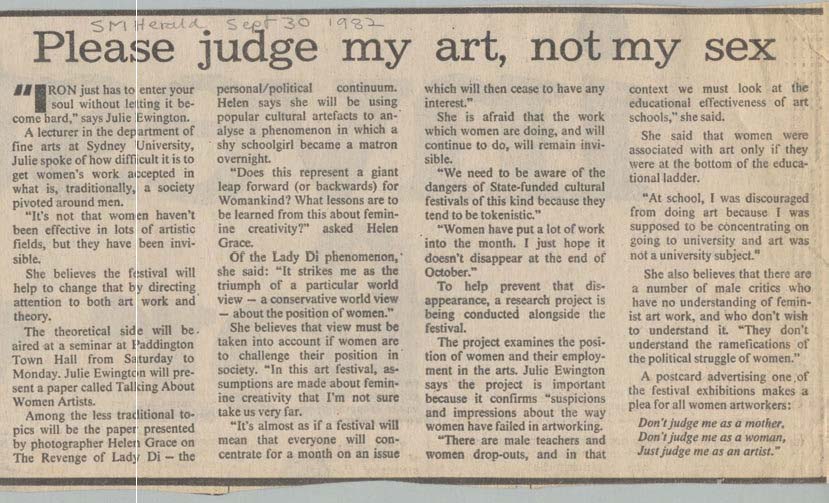
“Please Judge My Art, Not My Sex.” The Sydney Morning Herald, 30 September 1982. (Type: article) » Download PDFPlease Judge My Art, Not My Sex
“Iron just has to enter your soul without letting it become hard,” says Julie Ewington. A lecturer in the department of fine arts at Sydney University, Julie spoke of how difficult it is to get women’s work accepted in what is, traditionally, a society pivoted around men. “It’s not that women haven’t been effective in lots of artistic fields, but they have been invisible.
She believes the festival will help to change that by directing attention to both art work and theory. The theoretical side will be aired at a seminar at Paddington Town Hall from Saturday to Monday. Julie Ewington will present a paper called Talking About Women Artists. Among the less traditional topics will be the paper presented by photographer Helen Grace on The Revenge of Lady Di – the personal/political continuum. Helen says she will be using popular cultural artefacts to analyse a phenomenon in which a shy schoolgirl became a matron overnight.
“Does this represent a giant leap forward (or backwards) for Womankind? What lessons are to be learned from this about feminine creativity?” asked Helen Grace.
Of the Lady Di phenomenon, she said: “It strikes me as the triumph of a particular world view – a conservative world view – about the position of women.” She believes that view must be taken into account if women are to challenge their position in society. “In this art festival, assumptions are made about feminine creativity that I’m not sure take us very far.
“It’s almost as if a festival will mean that everyone will concentrate for a month on an issue which will then cease to have any interest.”
She is afraid that the work which women are doing, and will continue to do, will remain invisible.
“We need to be aware of the dangers of State-funded cultural festivals of this kind because they tend to be tokenistic. Women have put a lot of work into the month. I just hope it doesn’t disappear at the end of October.”
To help prevent that disappearance, a research project is being conducted alongside the festival. The project examines the position of women and their employment in the arts. Julie Ewington says the project is important because it confirms “suspicions and impressions about the way women have failed in artworking.
“There are male teachers and women drop-outs, and in that context we must look at the educational effectiveness of art schools,” she said.
She said that women were associated with art only if they were at the bottom of the educational ladder.
“At school, I was discouraged from doing art because I was supposed to be concentrating on going to university and art was not a university subject.”
She also believes that there are a number of male critics who have no understanding of feminist art work, and who don’t wish to understand it. “They don’t understand the ramifications of the political struggle of women.”
A postcard advertising one of the festival exhibitions makes a plea for all women artworkers:
Don’t judge me as a mother.
Don’t judge me as a woman.
Just judge me as an artist.