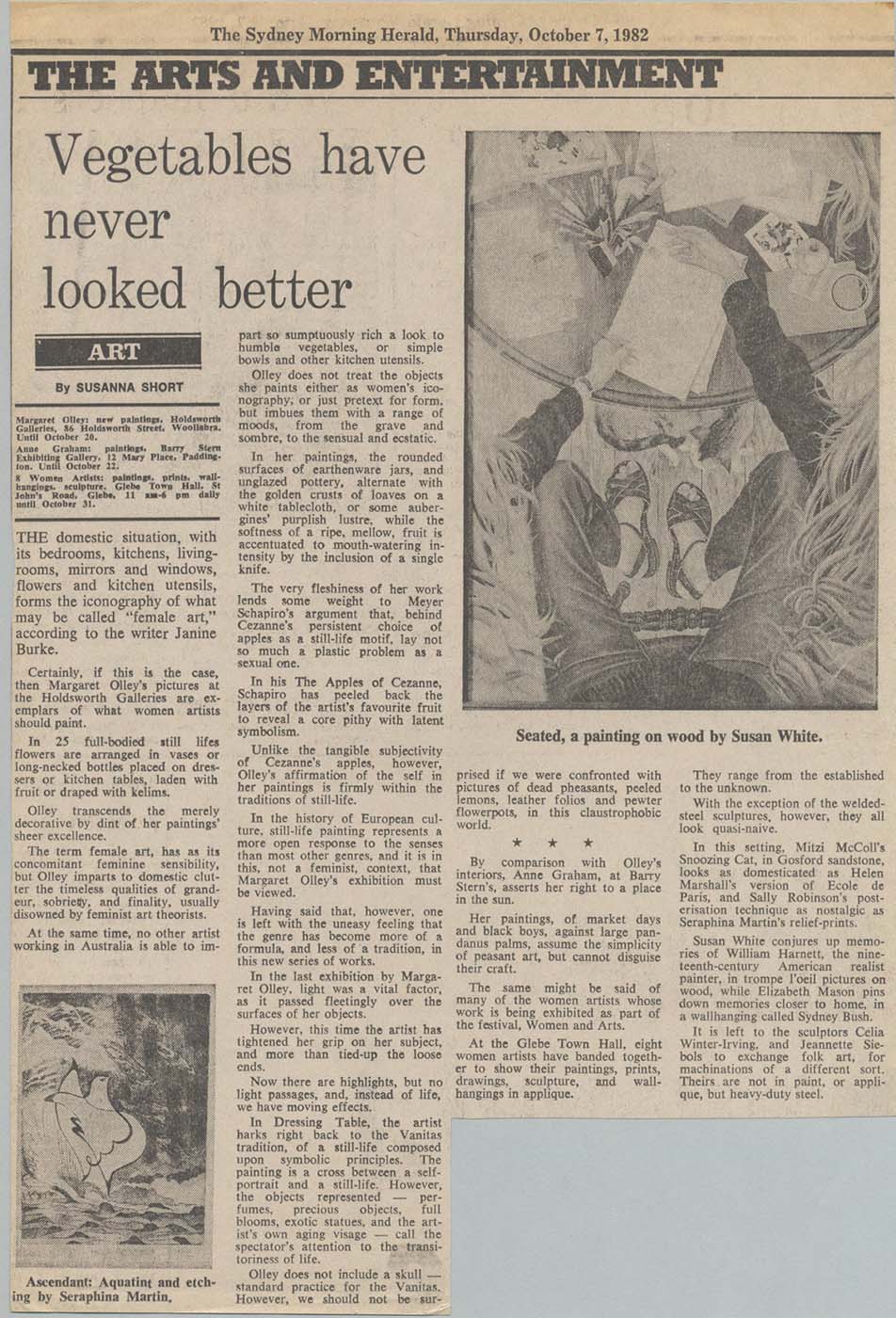
Short 1982
Short, Susanna. “Vegetables Have Never Looked Better.” The Sydney Morning Herald, The Arts and Entertainment, 7 October 1982. (Type: article) » Download PDFTHE domestic situation, with its bedrooms, kitchens, living-rooms, mirrors and windows, flowers and kitchen utensils, forms the iconography of what may be called “female art,” according to the writer Janine Burke. Certainly, if this is the case, then Margaret Olley’s pictures at the Holdsworth Galleries are exemplars of what women artists should paint. In 25 full-bodied still lifes flowers are arranged in vases or long-necked bottles placed on dressers or kitchen tables, laden with fruit or draped with Kelims. Olley transcends the merely decorative by dint of her paintings’ sheer excellence.
The term female art, has as its concomitant feminine sensibility, but Olley imparts to domestic clutter the timeless qualities of grandeur, sobriety, and finality, usually disowned by feminist art theorists. At the same time, no other artist working in Australia is able to impart so sumptuously rich a look to humble vegetables, or simple bowls and other kitchen utensils. Olley does not treat the objects she paints either as women’s iconography, or just pretext for form, but imbues them with a range of moods, from the grave and sombre, to the sensual and ecstatic.
In her paintings, the rounded surfaces of earthenware jars, and unglazed pottery, alternate with the golden crusts of loaves on a white tablecloth, or some aubergines’ purplish lustre, while the softness of a ripe, mellow, fruit is accentuated to mouth-watering intensity by the inclusion of a single knife.
The very fleshiness of her work lends some weight to Meyer Schapiro’s argument that, behind Cezanne’s persistent choice of apples as a still-life motif, lay not so much a plastic problem as a sexual one. In his The Apples of Cezanne, Schapiro has peeled back the layers of the artist’s favourite fruit to reveal a core pithy with latent symbolism.
Unlike the tangible subjectivity of Cezanne’s apples, however, Olley’s affirmation of the self in her paintings is firmly within the traditions of still-life.
In the history of European culture, still-life painting represents a more open response to the senses than most other genres, and it is in this, not a feminist, context, that Margaret Olley’s exhibition must be viewed.
Having said that, however, one is left with the uneasy feeling that the genre has become more of a formula, and less of a tradition, in this new series of works.
In the last exhibition by Margaret Olley, light was a vital factor, as it passed fleetingly over the surfaces of her objects. However, this time the artist has tightened her grip on her subject, and more than tied-up the loose ends. Now there are highlights, but no light passages, and, instead of life, we have moving effects.
In Dressing Table, the artist harks right back to the Vanitas tradition, of a still-life composed upon symbolic principles. The painting is a cross between a self-portrait and a still-life. However, the objects represented — perfumes, precious objects, full blooms, exotic statues, and the artist’s own aging visage — call the spectator’s attention to the transitoriness of life.
Olley does not include a skull — standard practice for the Vanitas. However, we should not be surprised if we were confronted with pictures of dead pheasants, peeled lemons, leather folios and pewter flowerpots, in this claustrophobic world. By comparison with Olley’s interiors, Anne Graham, at Barry Stern’s, asserts her right to a place in the sun. Her paintings, of market days and black boys, against large pandanus palms, assume the simplicity of peasant art, but cannot disguise their craft.
The same might be said of many of the women artists whose work is being exhibited as part of the festival, Women and Arts. At the Glebe Town Hall, eight women artists have banded together to show their paintings, prints, drawings, sculpture, and wall-hangings in applique. They range from the established to the unknown.
With the exception of the welded-steel sculptures, however, they all look quasi-naive. In this setting, Mitzi McColl’s Snoozing Cat, in Gosford sandstone, looks as domesticated as Helen Marshall’s version of École de Paris, and Sally Robinson’s posterisation technique as nostalgic as Seraphina Martin’s relief-prints.
Susan White conjures up memories of William Harnett, the nineteenth-century American realist painter, in trompe l’oeil pictures on wood, while Elizabeth Mason pins down memories closer to home, in a wallhanging called Sydney Bush.
It is left to the sculptors Celia Winter-Irving, and Jeannette Siebols to exchange folk art, for machinations of a different sort. Theirs are not in paint, or applique, but heavy-duty steel.