Saw 1982
Saw, Andrew. “Sexual Paranoia Meets the Floating Rock-Pile.” The Weekend Australian, 16–17 October 1982, p. 16. (Type: article) » Download PDFSexual paranoia meets the floating rock-pile
By ANDREW SAW
THE question flexing Sydney art minds at present is this: Are women artists better than men artists, and if not, why not? This burning, though obviously silly, issue has been brought to a head by the Women and Arts Festival which has virtually run amok with ladies’ art exhibitions.
Now, before feminists with firm views begin flexing their biceps, it should be pointed out that all these exhibitions (at least a dozen) prove but one thing: There are as many hopeless woman artists as there are hopeless men artists. And, just to make sure there is no confusion, it also proved (he said taking a deep breath) that there are as many good women artists as . . . well, you get the drift I’m sure. The point, I think, is that aside from fundamental plumbing differences, people are people, artists are artists and that’s all there is to it.
Nevertheless, sexual politics being what they are, one couldn’t help experiencing some paranoia while doing the gallery rounds. The fact that the first three galleries were filled with what I perceived to be boring, derivative, hopelessly bland rubbish didn’t help. Was this the male perception being incapable of appreciating female perception? Was I a victim of (slightly unfashionable) heterosexuality?
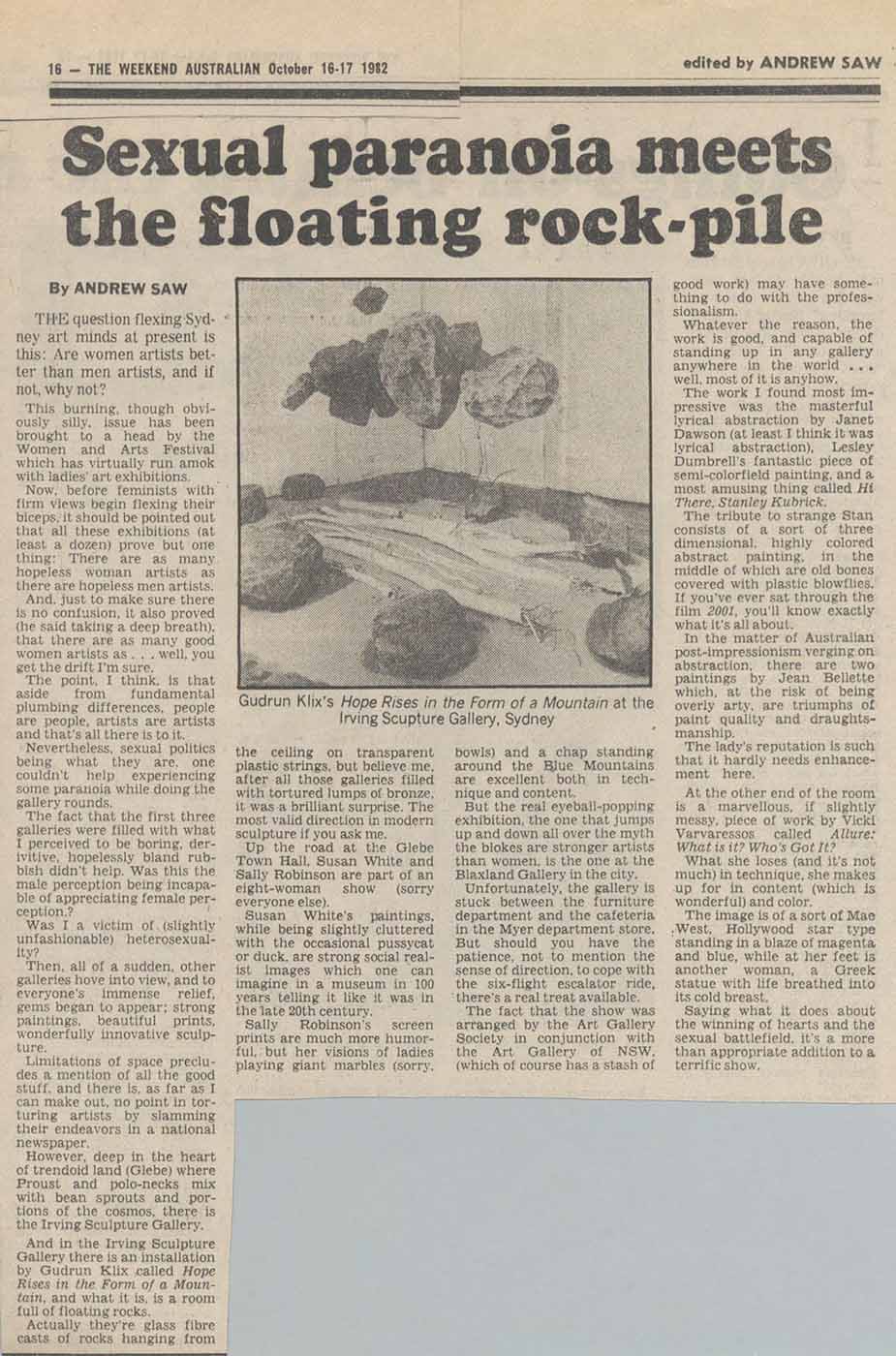
Then, all of a sudden, other galleries hove into view, and to everyone’s immense relief, gems began to appear; strong paintings, beautiful prints, wonderfully innovative sculpture. Limitations of space precludes a mention of all the good stuff, and there is, as far as I can make out, no point in torturing artists by slamming their endeavors in a national newspaper. However, deep in the heart of trendoid land (Glebe) where Proust and polo-necks mix with bean sprouts and portions of the cosmos, there is the Irving Sculpture Gallery. And in the Irving Sculpture Gallery there is an installation by Gudrun Klix called Hope Rises in the Form of a Mountain, and what it is, is a room-full of floating rocks.
Actually they’re glass fibre casts of rocks hanging from the ceiling on transparent plastic strings, but believe me, after all those galleries filled with tortured lumps of bronze, it was a brilliant surprise. The most valid direction in modern sculpture if you ask me. Gudrun Klix’s Hope Rises in the Form of a Mountain at the Irving Sculpture Gallery, Sydney
Up the road at the Glebe Town Hall, Susan White and Sally Robinson are part of an eight-woman show (sorry everyone else).
Susan White’s paintings, while being slightly cluttered with the occasional pussycat or duck, are strong social realist images which one can imagine in a museum in 100 years telling it like it was in the late 20th century.
Sally Robinson’s screen prints are much more humorful, but her visions of ladies playing giant marbles (sorry, bowls) and a chap standing around the Blue Mountains are excellent both in technique and content. But the real eyeball-popping exhibition, the one that jumps up and down all over the myth the blokes are stronger artists than women, is the one at the Blaxland Gallery in the city. Unfortunately, the gallery is stuck between the furniture department and the cafeteria in the Myer department store. But should you have the patience, not to mention the sense of direction, to cope with the six-flight escalator ride, there’s a real treat available. The fact that the show was arranged by the Art Gallery Society in conjunction with the Art Gallery of NSW, (which of course has a stash of good work) may have something to do with the professionalism. Whatever the reason, the work is good, and capable of standing up in any gallery anywhere in the world . . . well, most of it is anyhow.
The work I found most impressive was the masterful lyrical abstraction by Janet Dawson (at least I think it was lyrical abstraction), Lesley Dumbrell’s fantastic piece of semi-colorfield painting, and a most amusing thing called Hi There, Stanley Kubrick.
The tribute to strange Stan consists of a sort of three dimensional, highly colored abstract painting, in the middle of which are old bones covered with plastic blowflies. If you’ve ever sat through the film 2001, you’ll know exactly what it’s all about.
In the matter of Australian post-impressionism verging on abstraction, there are two paintings by Jean Bellette which, at the risk of being overly arty, are triumphs of paint quality and draughtsmanship. The lady’s reputation is such that it hardly needs enhancement here. At the other end of the room is a marvellous, if slightly messy, piece of work by Vicki Varvaressos called Allure: What is it? Who’s Got It?. What she loses (and it’s not much) in technique, she makes up for in content (which is wonderful) and color.
The image is of a sort of Mae West, Hollywood star type standing in a blaze of magenta and blue, while at her feet is another woman, a Greek statue with life breathed into its cold breast.
Saying what it does about the winning of hearts and the sexual battlefield, it’s a more than appropriate addition to a terrific show.